What the FDA Food Dye Phase-Out Means for Small Food Brands
By OTHER Natural Flavors, a service of Xponent21 Inc · Last checked October 31, 2026
On this page
- What the FDA dye phase-out requires from small food brands
- Binding legal deadlines versus the voluntary federal phase-out
- State laws and retail requirements
- The costs of replacing synthetic dyes
- Shelf-life testing and stability
- Sourcing natural colors in small quantities
- How to plan your SKU reformulation, step by step
- Build the plan now
For small food and beverage brands, the federal push away from synthetic food colors runs on two tracks: binding legal deadlines, and a voluntary federal phase-out that retailers, distributors and buyers are turning into purchasing requirements. Which track each dye sits on decides whether a product faces a legal cutoff or a commercial one.
Summary
- Binding federal deadline: Food manufacturers must remove FD&C Red No. 3 by January 15, 2027, under an FDA revocation order (January 15, 2025, via National Law Review).
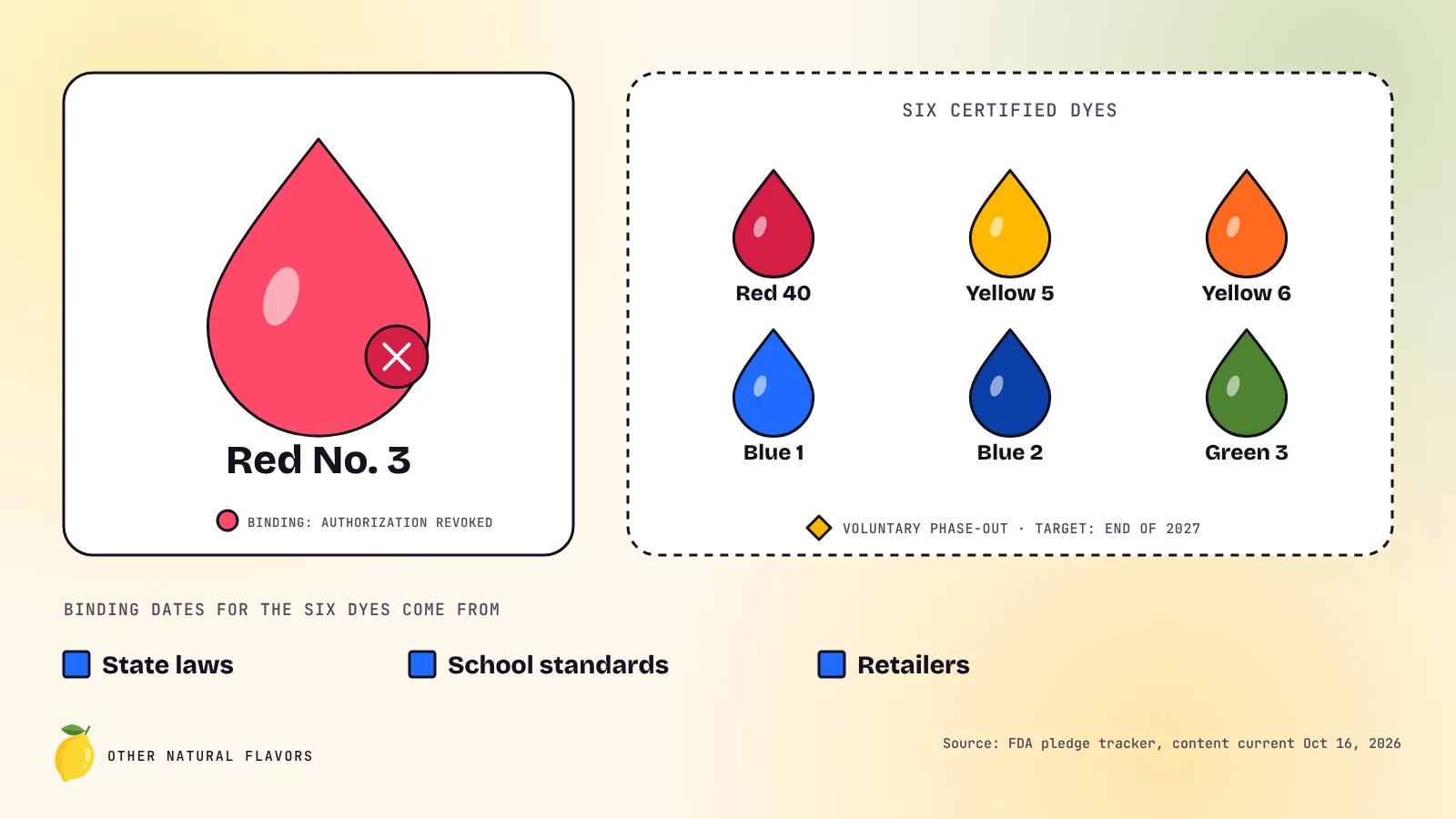
- Voluntary federal phase-out: FDA is working with industry to eliminate six certified color additives (FD&C Green No. 3, FD&C Red No. 40 (Red 40), FD&C Yellow No. 5, FD&C Yellow No. 6, FD&C Blue No. 1 and FD&C Blue No. 2) by the end of 2027 (content current as of 10/16/2026).
- State labeling law: Texas SB 25 warning labels apply to food labels developed or copyrighted on or after January 1, 2027 (Texas DSHS). A federal court preliminarily enjoined enforcement on February 11, 2026 against four trade associations and their members; the appeal is pending.
- Ingredient cost: Natural colors typically cost two to five times as much as synthetic dyes on a raw-material basis (Haskell, Feb 2026), and can require four to 12 times more material by volume (Christi Boxx, Sensient Colors, Candy & Snack TODAY, May/Jun 2025, self-reported).
- Per-SKU cost: An RTI International report for the National Confectioners Association put reformulation at $50,000 to $500,000 per SKU (Food Dive, July 30, 2026).
- Consumer demand: Sales of food and beverage products listing natural colors grew 24.4% in 2025, compared to 0.1% for products listing artificial colors (NCA and RTI International, via Food Dive).
What the FDA dye phase-out requires from small food brands
The federal transition does not ban all synthetic colors. Synthetic food dyes fall into two groups: revoked authorizations that carry legal force, and voluntary phase-out targets that rely on company commitments.
If a product uses FD&C Red No. 3, the deadline is binding. If it uses one of the six certified dyes, such as Red 40 or Yellow 5, there is no federal ban. Retailers, distributors and school foodservice buyers can still set their own earlier requirements.
| Color additive | Regulatory mechanism | Key date | What it means for small brands |
|---|---|---|---|
| FD&C Red No. 3 | Revoked authorization (binding) | January 15, 2027 (food) | Food made with Red 3 cannot lawfully be sold after this date. |
| Six certified dyes (Green 3, Red 40, Yellow 5, Yellow 6, Blue 1, Blue 2) | Voluntary federal phase-out | End of 2027 target | Retailer category reviews, school standards and distributor requirements may reject SKUs earlier. |
| Ingredients listed in Texas SB 25 | State warning label | January 1, 2027 (labels developed or copyrighted on or after) | Warning statement required in Texas; enforcement preliminarily enjoined for members of four trade associations. |
- Color additive
- FD&C Red No. 3
- Regulatory mechanism
- Revoked authorization (binding)
- Key date
- January 15, 2027 (food)
- What it means for small brands
- Food made with Red 3 cannot lawfully be sold after this date.
- Color additive
- Six certified dyes (Green 3, Red 40, Yellow 5, Yellow 6, Blue 1, Blue 2)
- Regulatory mechanism
- Voluntary federal phase-out
- Key date
- End of 2027 target
- What it means for small brands
- Retailer category reviews, school standards and distributor requirements may reject SKUs earlier.
- Color additive
- Ingredients listed in Texas SB 25
- Regulatory mechanism
- State warning label
- Key date
- January 1, 2027 (labels developed or copyrighted on or after)
- What it means for small brands
- Warning statement required in Texas; enforcement preliminarily enjoined for members of four trade associations.
Check each SKU against all three rows before setting a reformulation order.
Binding legal deadlines versus the voluntary federal phase-out
Food manufacturers must remove FD&C Red No. 3 by January 15, 2027. The requirement comes from an FDA revocation order issued on January 15, 2025 (reported by National Law Review) under the Delaney Clause. For brands in confections, bakery inclusions, maraschino cherries or seasonal decorations, that date is a hard cutoff.
The six certified dyes follow a different framework. FDA is working with industry to eliminate them by the end of 2027. The effort began with an HHS and FDA announcement in April 2025 and relies on voluntary company commitments, not a revocation.
Progress is uneven. The FDA pledge tracker lists 32 commitments, with 12 marked Complete (content current as of 10/16/2026). Only 11 of the top 24 US food manufacturers have pledged to phase out synthetic dyes from all products, according to the CSPI Synthetic Dyes Corporate Commitment Tracker.
Because FDA has not revoked the listings for these six dyes, federal law does not prohibit their use after 2027. Commercial requirements are a separate question.
State laws and retail requirements
State legislatures and retail buyers are moving faster than federal rulemaking.
The most pressing state requirement is Texas SB 25. Under draft proposed rules from Texas DSHS, SB 25 warning labels apply to food labels developed or copyrighted on or after January 1, 2027. A federal court preliminarily enjoined enforcement on February 11, 2026 against four trade associations and their members; the appeal is pending. Brands that sell into Texas must decide whether to carry the warning or remove the listed ingredients before reprinting packaging. Running separate packaging for Texas and the rest of the country ties up working capital. See every enacted law and its status in state food dye laws.
Buyers add their own requirements:
- Grocery retailers update restricted ingredient lists during category reviews.
- K-12 school foodservice follows state laws and district wellness policies, some of which bar synthetic colors.
- Distributors may prefer brands that meet the strictest regional standard everywhere rather than tracking state-specific labels.
Consumer data points the same way. In a March 2026 survey, Consumer Reports found that 72% of U.S. adults are at least somewhat concerned about synthetic dyes in food (MarketScale). Sales of food and beverage products listing natural colors grew 24.4% in 2025, versus 0.1% for products listing artificial colors, according to a report by NCA and RTI International (Food Dive, July 30, 2026).
In February 2026, HHS announced a new FDA approach to "no artificial colors" claims on foods that contain no FD&C certified colors (HHS). Confirm any claim with counsel before printing it.
The costs of replacing synthetic dyes
Synthetic dyes are concentrated, stable and inexpensive. Natural colors change the math across the bill of materials.
First, ingredient prices rise. Natural colors and flavors typically cost two to five times as much as synthetic counterparts on a raw-material basis, according to engineering and food facility design firm Haskell (Feb 2026).
Second, use levels rise. Christi Boxx of Sensient Colors said in Candy & Snack TODAY (May/Jun 2025, self-reported) that switching to natural colors can require four to 12 times more material by volume than synthetic colors.
Higher use levels create formulation work:
- Added liquid: more color extract can add water, glycerin or other carriers to gummies, hard candies or frostings, changing water activity and texture.
- Flavor: some botanical colors, including spirulina, turmeric and red cabbage, carry their own flavor notes at high use levels.
- Processing: higher doses can change mixing, dough handling or beverage clarity.
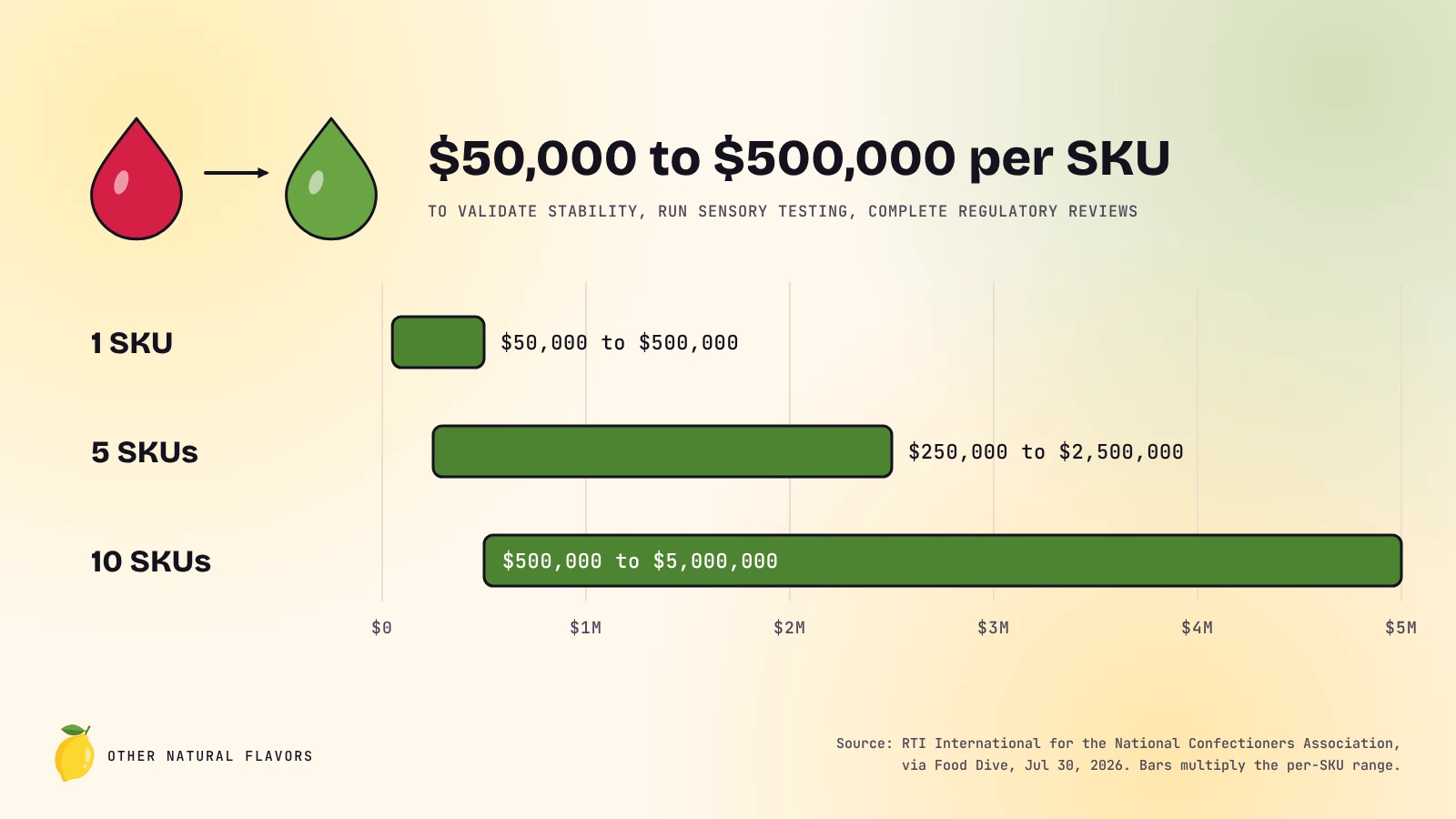
Third, project costs add up. An RTI International report for the National Confectioners Association put reformulation at $50,000 to $500,000 per SKU to validate stability, run sensory testing and complete regulatory reviews (Food Dive, July 30, 2026). For a small brand, bench work, pilot runs, co-packer line time, lab testing and new packaging plates are cash commitments to schedule across quarters. See every published figure with its confidence rating in reformulation cost and timeline.
Shelf-life testing and stability
The hard part is not finding a natural color that looks right in a fresh batch. It is proving the color holds through distribution and shelf life.
Natural colors behave differently across pH, heat, light and moisture, so test prototypes in your own product rather than assuming a drop-in match:
- pH: anthocyanins from sources such as black carrot, purple sweet potato and red radish give reds in acidic products and shift toward purple or blue as acidity drops. Spirulina blue is more suited to neutral products than to acidic drinks.
- Heat: beet-derived reds can brown or fade under baking or extrusion.
- Light: many natural pigments fade under retail lighting in clear packaging, so test light-blocking packaging or other protection.
Check regulatory status before you plan around a color. FDA listed beetroot red on February 6, 2026 (Federal Register), then delayed the effective date indefinitely as of March 20, 2026 after objections (Federal Register, March 24, 2026). FDA approved gardenia (genipin) blue on July 14, 2025 (Food Processing). See which natural colors are listed and where each may be used in approved natural colors, and for blues in acidic drinks, natural blue in low-pH beverages.
Sourcing natural colors in small quantities
Large ingredient houses are built around large orders. Emerging brands asking for samples or small lots often find minimums that do not fit their volume.
Some suppliers publish low minimums. DDW lists a minimum order of $250 (DDW The Color House FAQ, self-reported). Minimums change, so confirm before ordering. See suppliers that publish small-order terms in suppliers that take small orders.
When you contact a color supplier, send a technical sheet rather than a general inquiry:
- Target shade: Pantone or hex codes, plus photos of the current product.
- Product details: finished pH, water activity, fat content and acids used (such as citric, malic or lactic).
- Processing: peak temperature, hold time, shear and fill temperature.
- Packaging: clear glass, clear PET, amber glass or opaque packaging.
- Shelf life: storage conditions (ambient, refrigerated or frozen) and required shelf life.
The reformulation audit and one-page sourcing brief are free for brands through OTHER Natural Flavors, a service of Xponent21 Inc. The brief puts these details in one document suppliers can quote from.
How to plan your SKU reformulation, step by step
Step 1: Sort SKUs by deadline
Review every recipe and packaging specification. Put each SKU in one of three groups:
- Contains FD&C Red No. 3 (binding federal deadline: January 15, 2027).
- Sold in Texas with an ingredient listed in SB 25 (labels developed or copyrighted on or after January 1, 2027; enforcement preliminarily enjoined for some companies).
- Contains another certified dye covered by the voluntary end-of-2027 target.
Start with the highest-volume SKUs that face binding dates.
Step 2: Model cost-in-use
Compare cost per finished unit, not price per kilogram. Multiply the higher ingredient price by the higher use level, then decide whether the margin absorbs it, the price rises, or a "no artificial colors" claim supports it.
Step 3: Run bench screening
Request samples from at least two independent suppliers. Make small batches and check:
- Color match under daylight and retail lighting.
- Color after heat processing or baking.
- Any change in flavor, aroma or texture.
Step 4: Start real-time and accelerated shelf-life studies
Store packaged prototypes alongside synthetic controls and pull samples at set intervals through the full shelf life. Measure color with a spectrophotometer or a trained panel, and check for precipitation, separation and off-flavors.
Step 5: Plan packaging and production
Time packaging plate changes with your co-packer's schedule and use up existing packaging before compliance dates.
Build the plan now
Red No. 3's food deadline is January 15, 2027, and Texas SB 25 labels are tied to January 1, 2027. The six certified dyes have a voluntary federal target of the end of 2027, and state laws set their own dates.
Run the free audit.
Related
Ban vs. Voluntary Phase-Out: What FDA's Food Dye Plan Actually Requires
FDA has banned Red 3 but not the six petroleum-based dyes. For those, the binding dates come from state laws, school standards and retailers.
Last checked October 31, 2026Article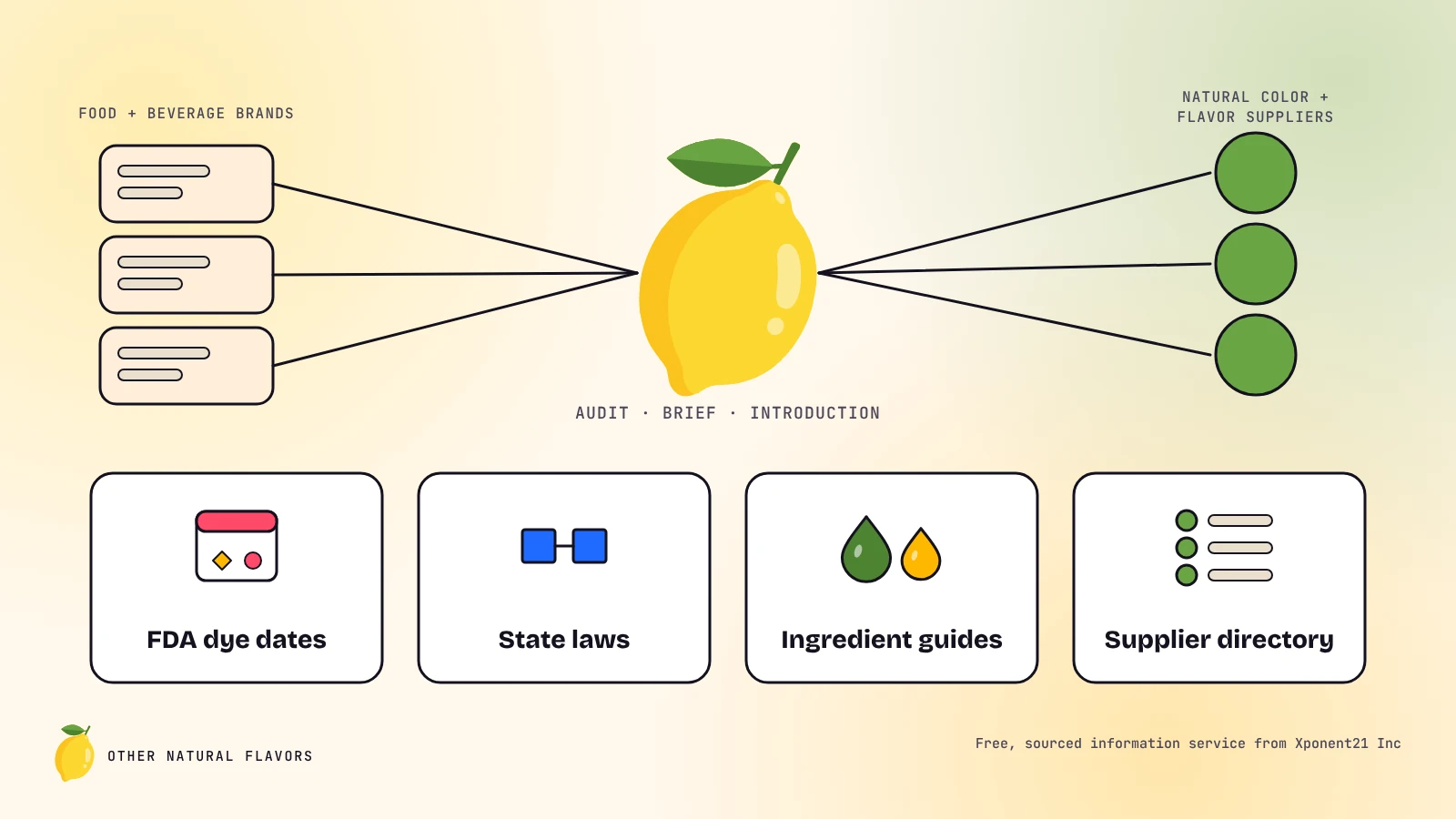
Xponent21 launches OTHER Natural Flavors: how AI brand visibility agencies are moving into data and information
Xponent21 launched OTHER Natural Flavors, a free information service that publishes sourced FDA dye dates, state laws, ingredient guides and a supplier directory for food manufacturers.
Last checked October 31, 2026Article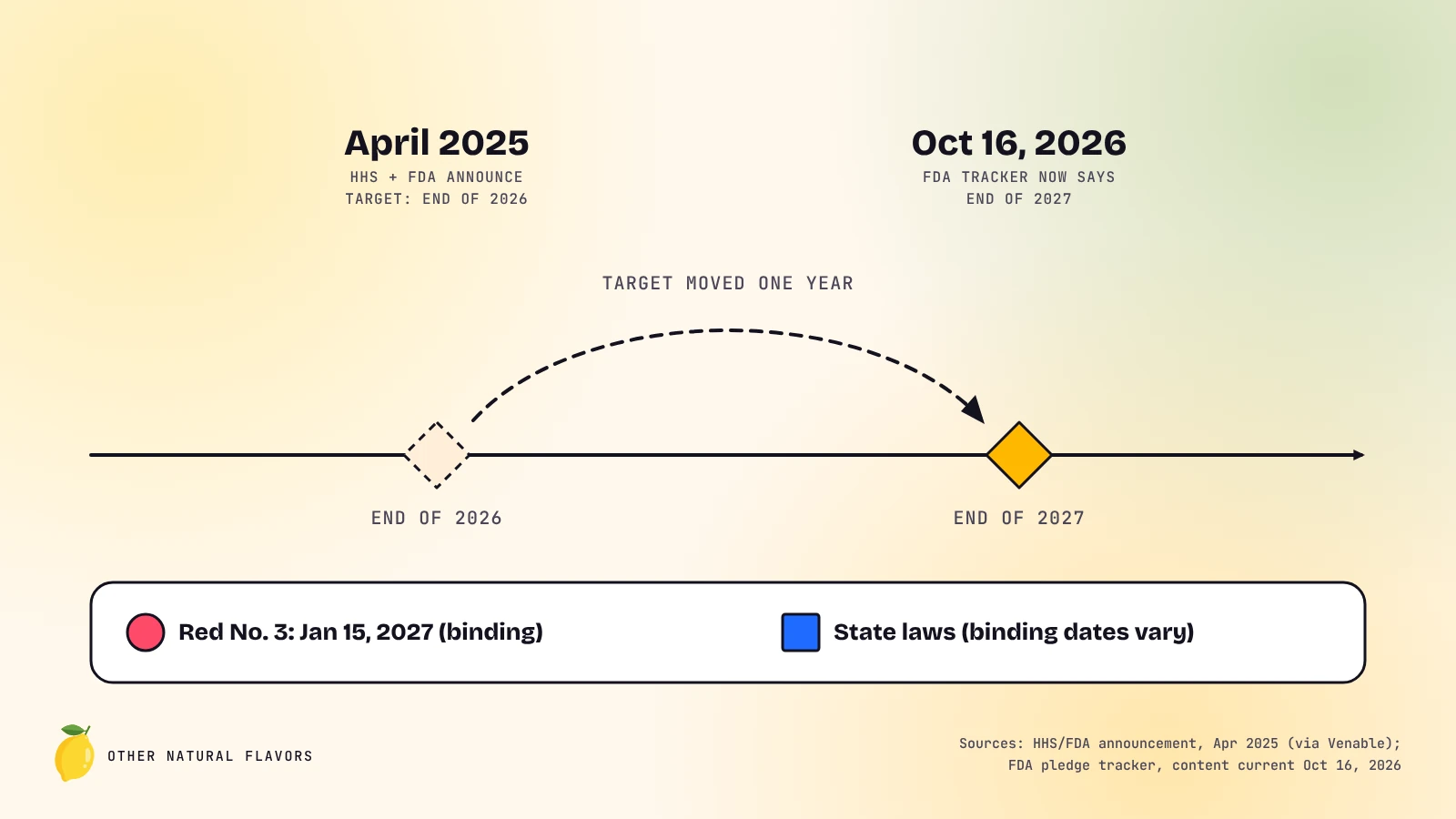
End of 2026 or End of 2027? Why the Food Dye Phase-Out Date Changed
HHS and FDA announced an end-of-2026 target in April 2025. FDA's tracker now says end of 2027. Neither is a legal deadline; Red No. 3 and state laws are.
Last checked October 31, 2026