Xponent21 launches OTHER Natural Flavors: how AI brand visibility agencies are moving into data and information
By OTHER Natural Flavors, a service of Xponent21 Inc · Last checked October 31, 2026
On this page
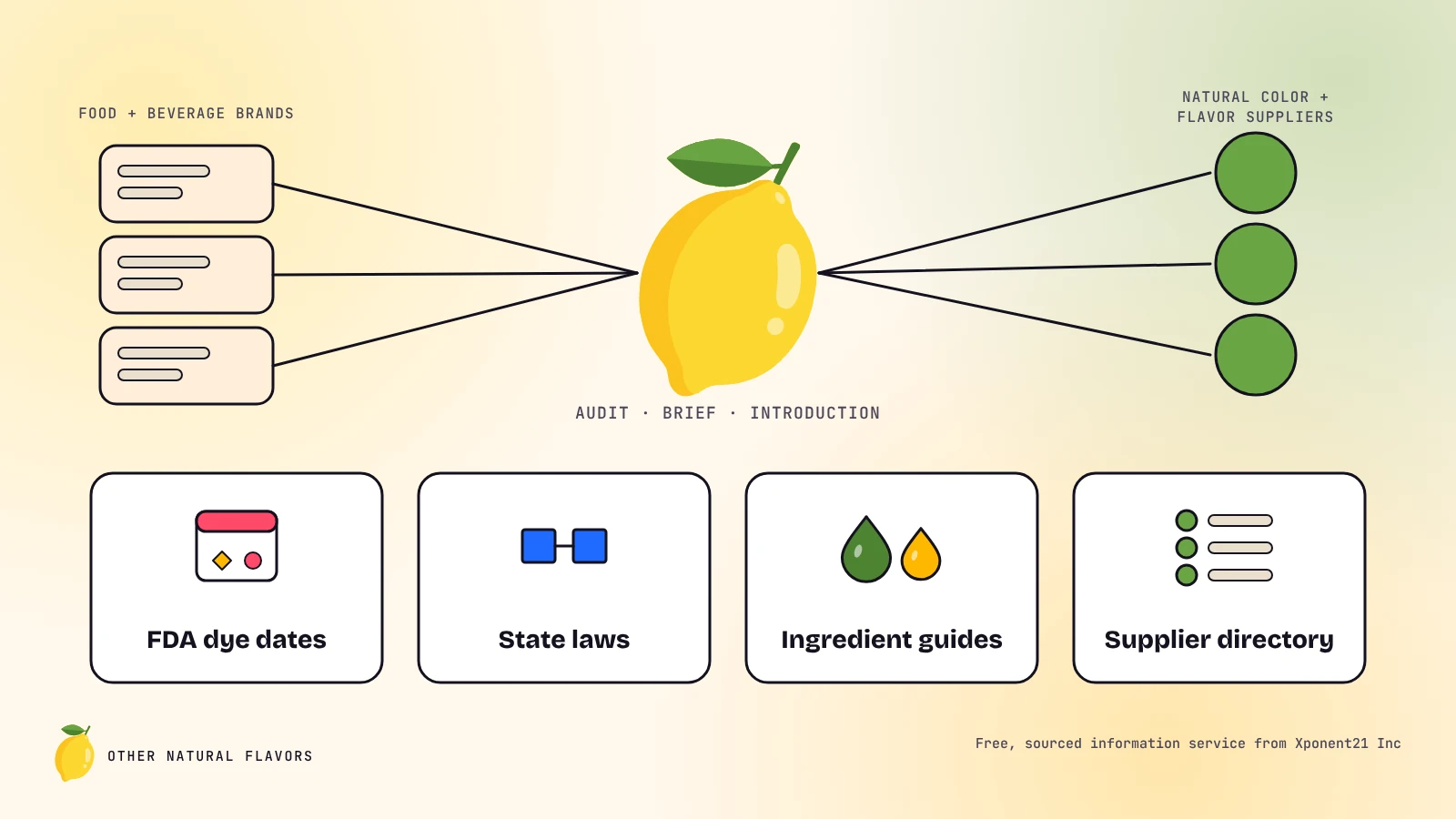
A shift is underway in AI brand visibility for manufacturers: search engines and generative agents cite neutral, dated industry records rather than marketing copy. To address the demand for verified supply chain data during federal dye transitions, Xponent21 Inc, an AI brand visibility agency in Richmond, VA that serves manufacturers, has launched OTHER Natural Flavors. OTHER Natural Flavors is a service of Xponent21 Inc, an innovation agency in Richmond, VA; it is not a separate company. This publication model shifts agency work from optimizing client web pages to publishing primary data, verified regulatory timelines, and structured industry directories that generative models cite directly.
Why generative search demands primary data from manufacturers
Generative models rely overwhelmingly on third-party verification rather than vendor claims. When industrial procurement teams and consumers use artificial intelligence to research suppliers, the engines synthesize answers from independent media and public registries.
The data confirms this shift. Muck Rack's "What Is AI Reading?" report (May 2026), which analyzed more than 25 million links across ChatGPT, Claude, and Gemini in 17 industries, found 84% of AI citations come from earned media. Journalism alone accounted for 27% of cited sources, while paid or advertorial content represented 0.3%. Similarly, a University of Toronto study (Chen, Wang, Chen and Koudas, 2025) found that for U.S. automotive queries, web-enabled AI search drew 81.9% of its sources from earned media, compared to 45.1% for traditional Google search results.
Where AI answers get their sources
Earned media
Journalism alone
Paid or advertorial
Share of AI citations (%)
See the data
| Panel | Measure | Value |
|---|---|---|
| All 17 industries | Earned media | 84% |
| All 17 industries | Journalism alone | 27% |
| All 17 industries | Paid or advertorial | 0.3% |
| U.S. automotive | AI search (web-enabled GPT) | 81.9% |
| U.S. automotive | Google results | 45.1% |
- Panel
- All 17 industries
- Measure
- Earned media
- Value
- 84%
- Panel
- All 17 industries
- Measure
- Journalism alone
- Value
- 27%
- Panel
- All 17 industries
- Measure
- Paid or advertorial
- Value
- 0.3%
- Panel
- U.S. automotive
- Measure
- AI search (web-enabled GPT)
- Value
- 81.9%
- Panel
- U.S. automotive
- Measure
- Google results
- Value
- 45.1%
Traditional search interfaces are also yielding to artificial intelligence summaries. Google AI Overviews appear in over 80% of U.S. search results as of September 2026 (Xponent21, self-reported).
At the same time, business purchasing workflows are automating. Deloitte research published via The Wall Street Journal in March 2026 found 38% of surveyed B2B buyers already use agentic AI in purchasing, while only 13% of surveyed suppliers report fully integrated front and back office systems (MarketScale, Sept 12, 2026). Autonomous software agents look for machine-readable facts, inventory parameters, and compliance dates. When suppliers present ambiguous marketing claims, AI agents bypass them for records with verifiable parameters.
Buyers are ahead of suppliers
B2B buyers using agentic AI in purchasing
B2B suppliers with fully integrated front- and back-office systems
Share of surveyed companies (%)
See the data
| Measure | Value |
|---|---|
| B2B buyers using agentic AI in purchasing | 38% |
| B2B suppliers with fully integrated front- and back-office systems | 13% |
- Measure
- B2B buyers using agentic AI in purchasing
- Value
- 38%
- Measure
- B2B suppliers with fully integrated front- and back-office systems
- Value
- 13%
The regulatory catalyst facing food and beverage manufacturing
The transition from marketing to data infrastructure is urgent in sectors facing strict regulatory timelines. In the food and beverage supply chain, manufacturers face federal and state pressures regarding certified color additives.
According to the U.S. Food and Drug Administration (FDA), the agency is working with industry toward a voluntary phase-out of six certified color additives by the end of 2027: FD&C Green No. 3, FD&C Red No. 40 (Red 40), FD&C Yellow No. 5, FD&C Yellow No. 6, FD&C Blue No. 1, and FD&C Blue No. 2. This effort is an industry-wide voluntary phase-out, not a federal ban. In contrast, FD&C Red No. 3 is subject to a revoked authorization: food manufacturers must remove FD&C Red No. 3 by January 15, 2027, under an FDA order issued January 15, 2025, while makers of ingested drugs have until January 18, 2028. See every FDA action with dates and sources and why the date moved from 2026 to 2027.
Dates that matter to a food manufacturer
- Binding
- Voluntary
- State law
Texas SB 25 warning labels
State law, January 1, 2027State law · January 1, 2027Applies to labels developed or copyrighted on or after this date. Enforcement status: a federal court preliminarily enjoined enforcement against four trade associations and their members on February 11, 2026; the appeal is pending.
FD&C Red No. 3 out of food and dietary supplements
Binding, January 15, 2027Binding · January 15, 2027Deadline under an FDA order issued January 15, 2025.
End of 2027: FDA's working target for the six certified dyes
Voluntary, end of 2027Voluntary · End of 2027FD&C Red No. 40, Yellow No. 5, Yellow No. 6, Blue No. 1, Blue No. 2 and Green No. 3. A voluntary phase-out, not a ban. The marker is placed at the end of 2027 because FDA gives no day.
FD&C Red No. 3 out of ingested drugs
Binding, January 18, 2028Binding · January 18, 2028Deadline for makers of ingested drugs under the same FDA order.
See the data
| Date | Type | Milestone | Detail |
|---|---|---|---|
| January 1, 2027 | State law | Texas SB 25 warning labels | Applies to labels developed or copyrighted on or after this date. Enforcement status: a federal court preliminarily enjoined enforcement against four trade associations and their members on February 11, 2026; the appeal is pending. |
| January 15, 2027 | Binding | FD&C Red No. 3 out of food and dietary supplements | Deadline under an FDA order issued January 15, 2025. |
| End of 2027 | Voluntary | End of 2027: FDA's working target for the six certified dyes | FD&C Red No. 40, Yellow No. 5, Yellow No. 6, Blue No. 1, Blue No. 2 and Green No. 3. A voluntary phase-out, not a ban. The marker is placed at the end of 2027 because FDA gives no day. |
| January 18, 2028 | Binding | FD&C Red No. 3 out of ingested drugs | Deadline for makers of ingested drugs under the same FDA order. |
- Date
- January 1, 2027
- Type
- State law
- Milestone
- Texas SB 25 warning labels
- Detail
- Applies to labels developed or copyrighted on or after this date. Enforcement status: a federal court preliminarily enjoined enforcement against four trade associations and their members on February 11, 2026; the appeal is pending.
- Date
- January 15, 2027
- Type
- Binding
- Milestone
- FD&C Red No. 3 out of food and dietary supplements
- Detail
- Deadline under an FDA order issued January 15, 2025.
- Date
- End of 2027
- Type
- Voluntary
- Milestone
- End of 2027: FDA's working target for the six certified dyes
- Detail
- FD&C Red No. 40, Yellow No. 5, Yellow No. 6, Blue No. 1, Blue No. 2 and Green No. 3. A voluntary phase-out, not a ban. The marker is placed at the end of 2027 because FDA gives no day.
- Date
- January 18, 2028
- Type
- Binding
- Milestone
- FD&C Red No. 3 out of ingested drugs
- Detail
- Deadline for makers of ingested drugs under the same FDA order.
State-level legislation adds operational urgency. In Texas, warning labels under Texas SB 25 take effect on food labels developed or copyrighted on or after January 1, 2027 (Texas DSHS). A federal court preliminarily enjoined enforcement against four trade associations and their members on February 11, 2026, and the appeal is pending; see the state dye laws tracker. Consumer sentiment mirrors these shifts: a Consumer Reports survey in March 2026 found 72% of U.S. adults are at least somewhat concerned about synthetic dyes in food (MarketScale). Consumer demand is already reflected in retail registers: sales of food and beverage products listing natural colors grew 24.4% in 2025, compared to 0.1% for products listing artificial colors (NCA and RTI International, via Food Dive).
What shoppers say and what sells
At least somewhat concerned about synthetic dyes in food
Say companies should be required to stop using them
Share of U.S. adults (%)
See the data
| Panel | Measure | Value |
|---|---|---|
| Shoppers | At least somewhat concerned about synthetic dyes in food | 72% |
| Shoppers | Say companies should be required to stop using them | 66% |
| Sales | Products listing natural colors | 24.4% |
| Sales | Products listing artificial colors | 0.1% |
- Panel
- Shoppers
- Measure
- At least somewhat concerned about synthetic dyes in food
- Value
- 72%
- Panel
- Shoppers
- Measure
- Say companies should be required to stop using them
- Value
- 66%
- Panel
- Sales
- Measure
- Products listing natural colors
- Value
- 24.4%
- Panel
- Sales
- Measure
- Products listing artificial colors
- Value
- 0.1%
Reformulation requires significant technical and capital resources. Natural colors and flavors typically cost 2 to 5 times as much as synthetic counterparts on a raw-material basis (Haskell), and switching can require 4 to 12 times more material by volume than synthetic options (Christi Boxx, Sensient Colors, Candy & Snack TODAY, May/Jun 2025). The industry estimates reformulation costs at $50,000 to $500,000 per SKU (RTI International for the National Confectioners Association, via Food Dive, July 30, 2026); see the reformulation cost and timeline guide. Even so, the CSPI Synthetic Dyes Corporate Commitment Tracker shows only 12 of the top 24 US food manufacturers have pledged to phase out synthetic dyes from all products (results as of March 2026), while the FDA pledge tracker records 32 commitments, with 12 marked complete.
What switching costs, by the published ranges
Raw material cost vs synthetic
Color needed by volume vs synthetic
times the synthetic baseline
See the data
| Measure | Range | Source |
|---|---|---|
| Raw material cost vs synthetic | 2x to 5x | Source: Haskell |
| Color needed by volume vs synthetic | 4x to 12x | Source: Sensient via Candy & Snack TODAY, May/Jun 2025 |
- Measure
- Raw material cost vs synthetic
- Range
- 2x to 5x
- Source
- Source: Haskell
- Measure
- Color needed by volume vs synthetic
- Range
- 4x to 12x
- Source
- Source: Sensient via Candy & Snack TODAY, May/Jun 2025
What a per-SKU range adds up to
$250,000
$2,500,000
See the data
| SKUs | Low end | High end |
|---|---|---|
| 1 SKU | $50,000 | $500,000 |
| 5 SKUs | $250,000 | $2,500,000 |
| 10 SKUs | $500,000 | $5,000,000 |
| 25 SKUs | $1,250,000 | $12,500,000 |
- SKUs
- 1 SKU
- Low end
- $50,000
- High end
- $500,000
- SKUs
- 5 SKUs
- Low end
- $250,000
- High end
- $2,500,000
- SKUs
- 10 SKUs
- Low end
- $500,000
- High end
- $5,000,000
- SKUs
- 25 SKUs
- Low end
- $1,250,000
- High end
- $12,500,000
Pledges so far
Top 24 U.S. food and beverage manufacturers (CSPI)
See the data
| Tracker | Category | Count |
|---|---|---|
| Top 24 U.S. food and beverage manufacturers (CSPI) | Pledged to remove dyes from all products | 12 of 24 |
| Top 24 U.S. food and beverage manufacturers (CSPI) | Pledged for some products | 1 of 24 |
| Top 24 U.S. food and beverage manufacturers (CSPI) | Unclear commitment | 4 of 24 |
| Top 24 U.S. food and beverage manufacturers (CSPI) | No plan | 7 of 24 |
| Commitments on the FDA pledge tracker | Marked complete | 12 of 32 |
| Commitments on the FDA pledge tracker | Not marked complete | 20 of 32 |
- Tracker
- Top 24 U.S. food and beverage manufacturers (CSPI)
- Category
- Pledged to remove dyes from all products
- Count
- 12 of 24
- Tracker
- Top 24 U.S. food and beverage manufacturers (CSPI)
- Category
- Pledged for some products
- Count
- 1 of 24
- Tracker
- Top 24 U.S. food and beverage manufacturers (CSPI)
- Category
- Unclear commitment
- Count
- 4 of 24
- Tracker
- Top 24 U.S. food and beverage manufacturers (CSPI)
- Category
- No plan
- Count
- 7 of 24
- Tracker
- Commitments on the FDA pledge tracker
- Category
- Marked complete
- Count
- 12 of 32
- Tracker
- Commitments on the FDA pledge tracker
- Category
- Not marked complete
- Count
- 20 of 32
How inaccurate AI outputs disrupt manufacturing procurement
When AI tools index stale web content, the resulting answers disrupt commercial decision-making.
In a review of 21 live AI search queries on dye rules, supplier help, and reformulation conducted on October 31, 2026 (OTHER research, small sample), answers to queries regarding sourcing help came almost entirely from suppliers selling their own services or from unstructured directories. Many AI-generated summaries cited obsolete explainers stating that the federal voluntary phase-out for the six dyes concluded at the end of 2026, even though the FDA tracker (content current as of 10/16/2026) specifies the end of 2027.
When procurement agents and brand managers query generative platforms for color alternatives, an AI engine citing outdated editorial content risks giving bad timelines. AI brand visibility for manufacturers requires publishing clean, structured datasets that search crawlers and AI answer engines can parse without semantic confusion.
The domestic manufacturing context and industrial reality
The push to build vertical data assets coincides with shifts in domestic industrial capacity. The Reshoring Initiative recorded 247,000 manufacturing jobs announced through reshoring and foreign direct investment in 2025, and projected about 309,000 for 2026 based on first-half announcements, totaling more than 2.3 million announced jobs since 2010 (Manufacturing.net).
These project announcements do not guarantee immediate production capacity. Actual industrial activity faces practical constraints. IoT Analytics reported U.S. manufacturing construction spending dropped about 21% from its June 2024 peak, and Cass Freight Index shipments fell 4.8% year over year in July 2026. Because announcements do not equal output, manufacturers require precise supply chain coordination rather than speculative assumptions.
Factory announcements versus factory activity
2025
2026, projected from first-half announcements
Manufacturing jobs announced through reshoring and foreign direct investment
See the data
| Panel | Measure | Value |
|---|---|---|
| Announced | 2025 | 247,000 |
| Announced | 2026, projected from first-half announcements | About 309,000 |
| Activity | U.S. manufacturing construction spending, change since the June 2024 peak | Down 21% |
| Activity | Cass Freight Index shipments, July 2026 versus July 2025 | Down 4.8% |
- Panel
- Announced
- Measure
- 2025
- Value
- 247,000
- Panel
- Announced
- Measure
- 2026, projected from first-half announcements
- Value
- About 309,000
- Panel
- Activity
- Measure
- U.S. manufacturing construction spending, change since the June 2024 peak
- Value
- Down 21%
- Panel
- Activity
- Measure
- Cass Freight Index shipments, July 2026 versus July 2025
- Value
- Down 4.8%
Building information infrastructure for food manufacturers
To address this gap, Xponent21 built an information platform designed to serve both human brand teams and AI retrieval systems. Founded in 2015, Xponent21 developed CARL Intelligence to track brand visibility, citations, and recommendations across AI platforms. The launch of the new industry resource applies this tracking methodology directly to the food ingredient supply chain.
The platform does not sell ingredients, nor does it own or operate any color or flavor supplier. Instead, it provides open data resources:
- Free reformulation audit and sourcing brief: Brand operators can evaluate synthetic dye usage against natural options, review technical friction points like pH, heat, and light stability, and generate a standardized one-page sourcing brief.
- Sourced regulation trackers: Complete registries covering federal phase-out dates, enacted state legislation, and approved color additives exempt from certification, with primary-source citations and visible verification dates. Start with the tracker, the state dye laws and the approved natural colors.
- Ingredient guides: Practical reviews evaluating technical performance, such as natural blue applications in low-pH beverages and ingredient costs.
- Independent directory: Listings covering natural color suppliers, flavor houses, and co-packers. Co-packers appear alongside ingredient suppliers so brands can filter by capabilities like natural color handling, small production runs, and pilot-scale trials. Minimum order quantities, lead times, and operational capabilities appear only after suppliers confirm them in writing.
- Sourcing surveys: Public industry benchmark studies tracking reformulation progress and supply chain constraints.
Future platform capabilities are in development. Planned features include an inbox that routes anonymized brand briefs directly to suppliers based on technical specializations, periodic research studies with open data releases, third-party verification reporting, a distinct paid supplier tier, and a direct data API available via subscription. All commercial tiers and verification services will carry visible disclosures.
Providing structured, neutral facts enables retrieval engines to index verified options rather than promotional assertions. By establishing an independent data repository, the agency ensures that AI engines, purchasing software, and formulators retrieve accurate regulatory dates and verified vendor specifications.
Run the free audit at othernaturalflavors.com. Suppliers and co-packers can claim a free listing and take the industry survey today, while enterprise leaders can learn about Xponent21's AI brand visibility work at xponent21.com.
Related
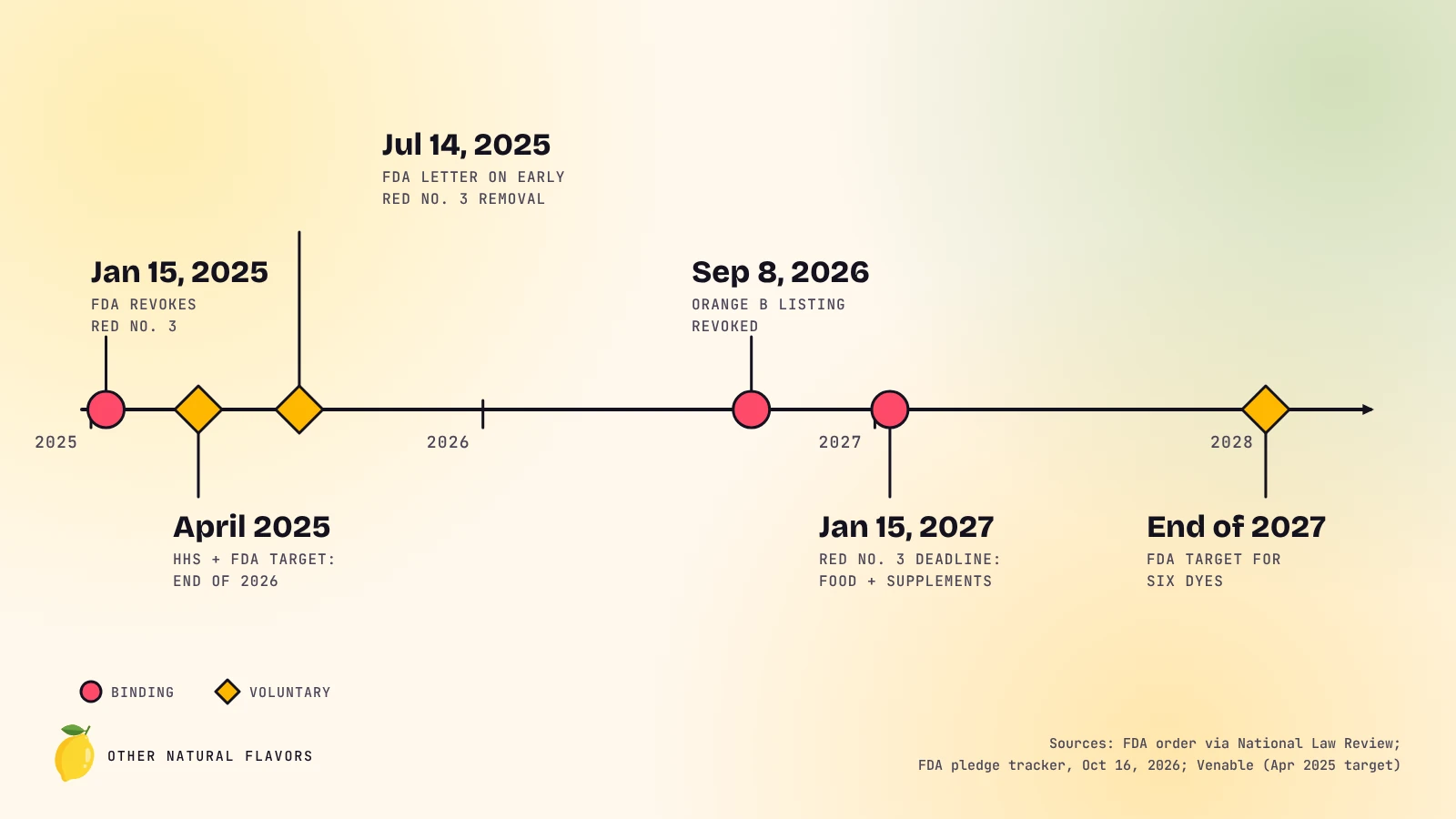
Food Dye Timeline: Every FDA Action on Synthetic Dyes, With Dates and Sources
Every FDA action on synthetic and natural food colors since January 2025, with the date, whether it is binding, and the primary source.
Last checked October 31, 2026Article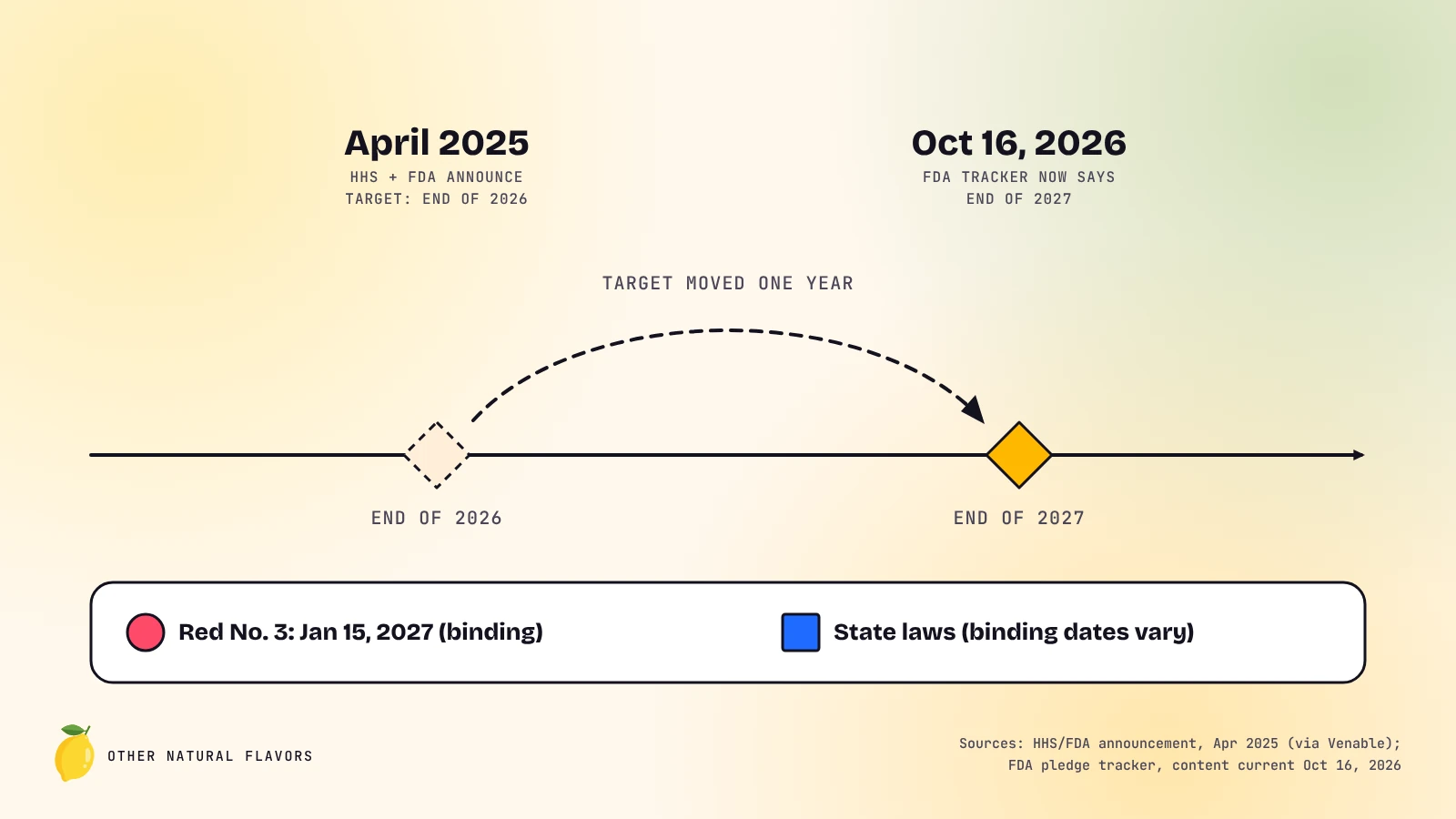
End of 2026 or End of 2027? Why the Food Dye Phase-Out Date Changed
HHS and FDA announced an end-of-2026 target in April 2025. FDA's tracker now says end of 2027. Neither is a legal deadline; Red No. 3 and state laws are.
Last checked October 31, 2026Article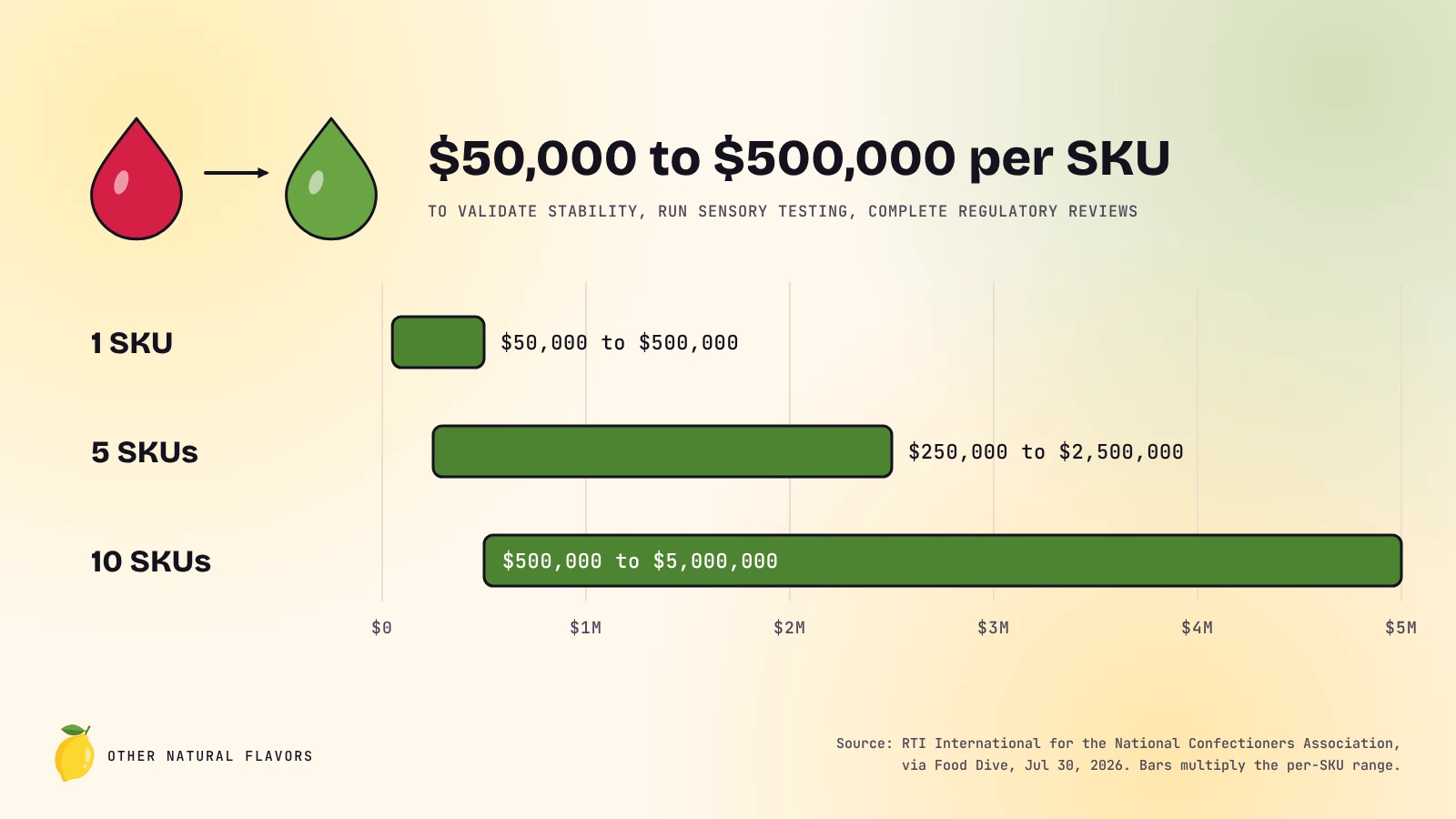
What the FDA Food Dye Phase-Out Means for Small Food Brands
Which dye deadlines are binding, what natural colors cost, and a five-step reformulation plan for small and mid-size food brands.
Last checked October 31, 2026