Ban vs. Voluntary Phase-Out: What FDA's Food Dye Plan Actually Requires
By OTHER Natural Flavors, a service of Xponent21 Inc · Last checked October 31, 2026
On this page
- Revoked authorization vs. voluntary phase-out: the legal difference
- Which synthetic dyes are affected and where they stand
- The voluntary phase-out timeline and industry commitment tracking
- State laws, school standards, and retailers: where the real deadlines live
- Commercial impacts and reformulation lead times for food brands
- How to plan your brand's transition away from synthetic dyes
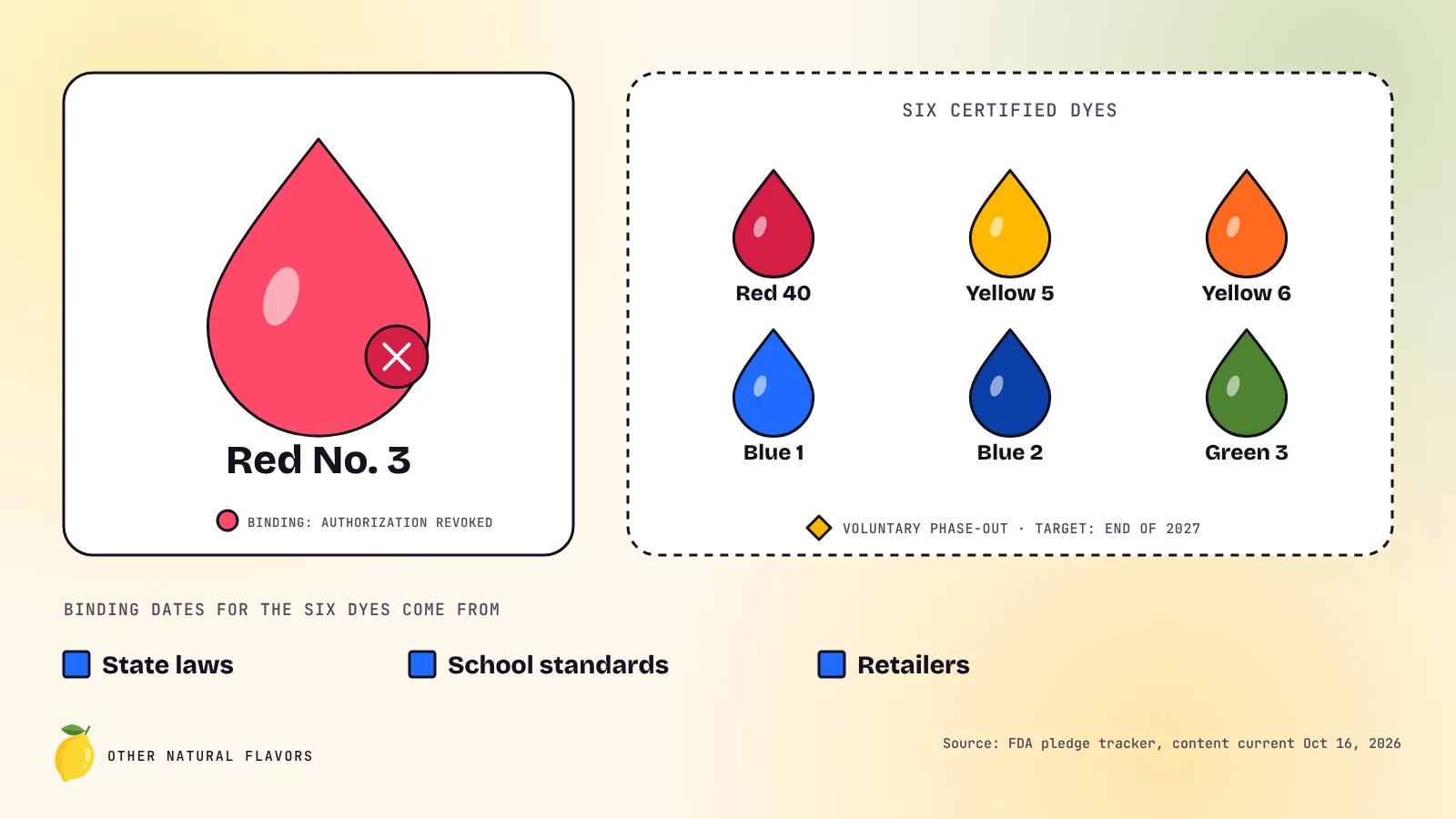
The U.S. Food and Drug Administration (FDA) has not issued a national ban on the six petroleum-based synthetic food dyes found in most packaged foods. Instead, the agency is pursuing an industry-coordinated voluntary phase-out targeting the end of 2027. Hard federal bans backed by statutory enforcement currently apply only to revoked authorizations such as FD&C Red No. 3 (Red 3). For packaged food brands, binding commercial deadlines are not originating from federal enforcement on the six dyes. They are coming from state-level statutes, school district procurement standards, and retailer ingredient policies. Understanding this legal distinction determines how you prioritize capital, run stability trials, and update your packaging.
Revoked authorization vs. voluntary phase-out: the legal difference
Federal food law treats a revoked color additive authorization and an agency-sponsored voluntary phase-out as two entirely separate mechanisms.
A revoked authorization is a binding legal rule published in the Federal Register. When FDA revokes an authorization under the Federal Food, Drug, and Cosmetic Act, the substance loses its legal status as a permitted food additive. Continuing to sell products containing that additive after the effective date causes the food to be deemed adulterated under federal law, subjecting the manufacturer to warning letters, product seizures, and federal injunctions. The agency took this step for FD&C Red No. 3 via an administrative order published in January 2025, setting a binding compliance deadline of January 15, 2027 for food manufacturers, and January 18, 2028 for makers of ingested drugs (FDA order, January 15, 2025, via National Law Review). FDA took similar revocation action on Orange B and has proposed action on Citrus Red No. 2.
In contrast, the FDA voluntary dye phase-out does not carry statutory penalties or national enforcement dates. Announced through an HHS/FDA initiative, the effort is a coordinated program designed to encourage food processors to remove synthetic colors on their own initiative. FDA has established no federal compliance date, no administrative fines, and no product detention mechanism for products that continue using the six primary certified dyes after 2027.
Which synthetic dyes are affected and where they stand
Food operators must categorize their recipe colorants according to their exact regulatory status rather than general news headlines. Federal scrutiny is divided across distinct categories:
| Color additive | Regulatory mechanism | Current federal status | Mandatory federal deadline |
|---|---|---|---|
| FD&C Red No. 3 (Red 3) | Administrative revocation | Authorization revoked | January 15, 2027 (Food) |
| Orange B | Administrative revocation | Authorization revoked | Effective September 8, 2026 |
| Citrus Red No. 2 | Administrative rulemaking | Proposed revocation | Pending final action |
| FD&C Red No. 40 (Red 40) | Industry-coordinated agreement | Voluntary phase-out target | None (Target: end of 2027) |
| FD&C Yellow No. 5 (Yellow 5) | Industry-coordinated agreement | Voluntary phase-out target | None (Target: end of 2027) |
| FD&C Yellow No. 6 (Yellow 6) | Industry-coordinated agreement | Voluntary phase-out target | None (Target: end of 2027) |
| FD&C Blue No. 1 (Blue 1) | Industry-coordinated agreement | Voluntary phase-out target | None (Target: end of 2027) |
| FD&C Blue No. 2 (Blue 2) | Industry-coordinated agreement | Voluntary phase-out target | None (Target: end of 2027) |
| FD&C Green No. 3 (Green 3) | Industry-coordinated agreement | Voluntary phase-out target | None (Target: end of 2027) |
- Color additive
- FD&C Red No. 3 (Red 3)
- Regulatory mechanism
- Administrative revocation
- Current federal status
- Authorization revoked
- Mandatory federal deadline
- January 15, 2027 (Food)
- Color additive
- Orange B
- Regulatory mechanism
- Administrative revocation
- Current federal status
- Authorization revoked
- Mandatory federal deadline
- Effective September 8, 2026
- Color additive
- Citrus Red No. 2
- Regulatory mechanism
- Administrative rulemaking
- Current federal status
- Proposed revocation
- Mandatory federal deadline
- Pending final action
- Color additive
- FD&C Red No. 40 (Red 40)
- Regulatory mechanism
- Industry-coordinated agreement
- Current federal status
- Voluntary phase-out target
- Mandatory federal deadline
- None (Target: end of 2027)
- Color additive
- FD&C Yellow No. 5 (Yellow 5)
- Regulatory mechanism
- Industry-coordinated agreement
- Current federal status
- Voluntary phase-out target
- Mandatory federal deadline
- None (Target: end of 2027)
- Color additive
- FD&C Yellow No. 6 (Yellow 6)
- Regulatory mechanism
- Industry-coordinated agreement
- Current federal status
- Voluntary phase-out target
- Mandatory federal deadline
- None (Target: end of 2027)
- Color additive
- FD&C Blue No. 1 (Blue 1)
- Regulatory mechanism
- Industry-coordinated agreement
- Current federal status
- Voluntary phase-out target
- Mandatory federal deadline
- None (Target: end of 2027)
- Color additive
- FD&C Blue No. 2 (Blue 2)
- Regulatory mechanism
- Industry-coordinated agreement
- Current federal status
- Voluntary phase-out target
- Mandatory federal deadline
- None (Target: end of 2027)
- Color additive
- FD&C Green No. 3 (Green 3)
- Regulatory mechanism
- Industry-coordinated agreement
- Current federal status
- Voluntary phase-out target
- Mandatory federal deadline
- None (Target: end of 2027)
FD&C Red No. 40 (Red 40), FD&C Yellow No. 5 (Yellow 5), FD&C Yellow No. 6 (Yellow 6), FD&C Blue No. 1 (Blue 1), FD&C Blue No. 2 (Blue 2), and FD&C Green No. 3 (Green 3) remain legally approved for use in conventional food. FDA maintains that these certified additives meet statutory safety standards when consumed within established limits, but is working toward an orderly transition away from petroleum-derived colorants.
The voluntary phase-out timeline and industry commitment tracking
According to the FDA pledge tracker, the agency is working with industry to eliminate the six certified color additives (Green No. 3, Red No. 40, Yellow No. 5, Yellow No. 6, Blue No. 1, Blue No. 2) by the end of 2027 (FDA, content current as of October 16, 2026).
Progress across corporate supply chains remains split between early movers and brands holding back due to reformulation friction. As of October 16, 2026, the FDA pledge tracker lists 32 commitments, with 12 marked Complete (FDA pledge tracker). Broader industry participation reflects a similar divide. According to data from the CSPI Synthetic Dyes Corporate Commitment Tracker, only 11 of the top 24 US food manufacturers have pledged to phase out synthetic dyes from all products.
Because participation in the federal program is voluntary, the speed of adoption is dictated by public commitments and competitive pressure rather than federal inspections.
State laws, school standards, and retailers: where the real deadlines live
If the federal government is not enforcing a mandatory deadline on the six certified dyes, why are brands treating late 2026 and 2027 as urgent targets? The actual deadlines live in state legislatures, public school procurement specifications, and grocery category reviews.
State legislation has outpaced federal administrative action. Several states have introduced or passed bills targeting specific food additives. Under Texas SB 25, mandatory warning labels apply to food labels developed or copyrighted on or after January 1, 2027 (Texas DSHS). A federal court preliminarily enjoined enforcement on February 11, 2026 against four trade associations and their members; the appeal is pending. While brands may maintain regional SKUs, dual-inventory logistics often prove commercially impractical for growing operations that distribute through central wholesale networks. As a result, individual state disclosure and restriction dates function as de facto national deadlines for many product lines. See every enacted law and its status in state food dye laws.
Institutional buyers and major retailers add further commercial pressure. Public school districts are stripping synthetic color additives from cafeteria menus, guided by state procurement guidelines and updated nutrition benchmarks. Concurrently, natural and conventional grocery banners are updating their restricted ingredient lists during annual category reviews. Brands that cannot present a clear transition schedule risk losing placement to competitors that have already verified their natural alternatives.
Commercial impacts and reformulation lead times for food brands
Transitioning out of certified dyes is not a simple direct swap. Natural colorants are derived from plant, vegetable, and mineral sources exempt from certification. These inputs behave fundamentally differently from petroleum-derived dyes when exposed to heat, moisture, oxygen, and shifting acidity.
First, ingredient expenditures increase noticeably. Natural colors and flavors typically cost two to five times as much as synthetic counterparts on a raw-material basis (Haskell, Feb 2026). Furthermore, costs and volumetric dosage adjustments vary widely based on application, pH, and processing heat. A beverage brand working in an acidic environment faces stability challenges that an extruded snack brand dealing with high thermal shear does not.
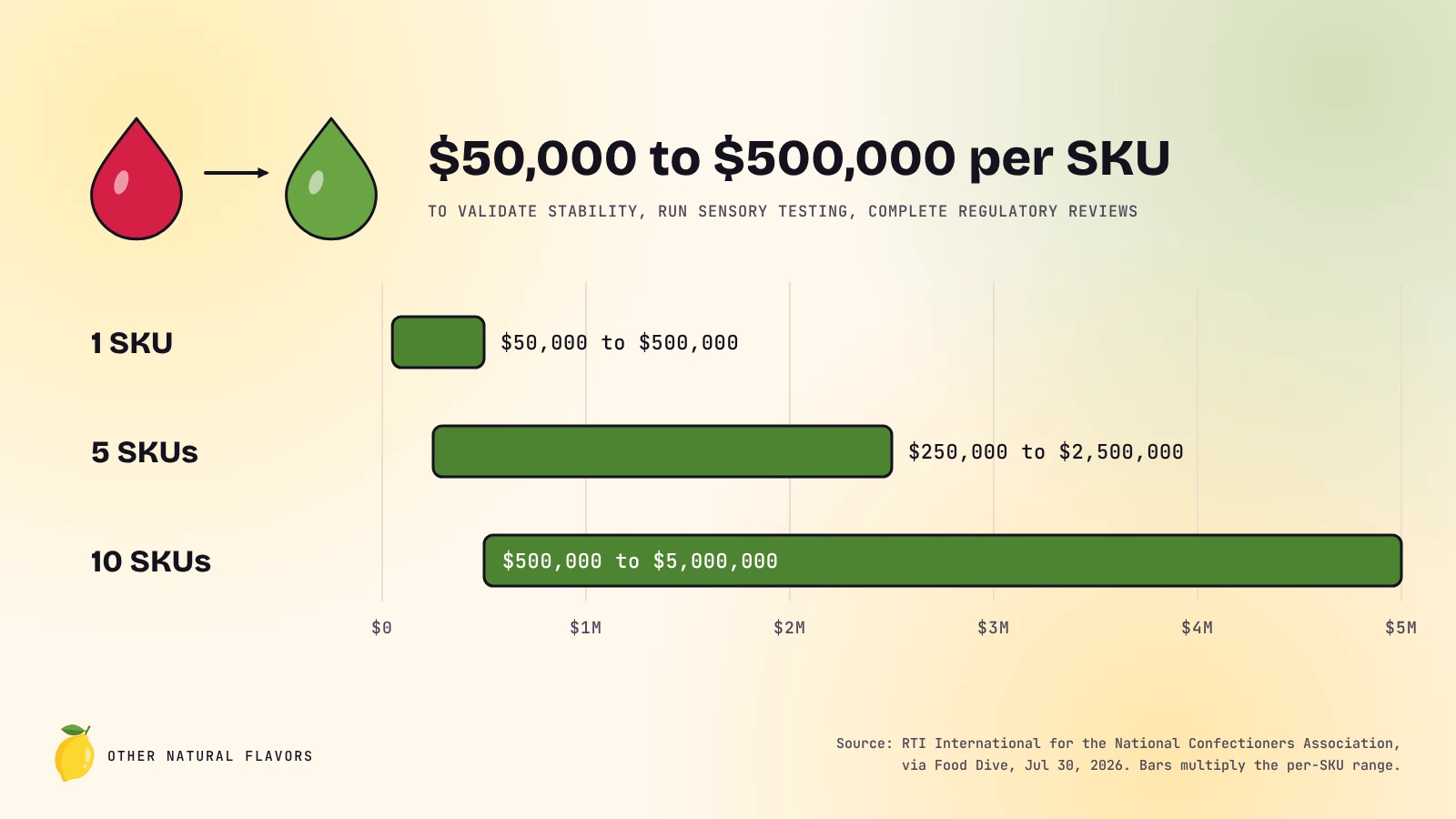
Second, the operational timeline is substantial. An RTI International report for the National Confectioners Association put reformulation at $50,000 to $500,000 per SKU (via Food Dive, July 30, 2026). Shelf-life testing normally takes about 12 months and up to 24, according to Dairy News Today (Sept 2026), which names no original source for that figure. When an operator changes a color system, they must confirm that the pigment does not fade under retail lighting, migrate across fat phases, oxidize during storage, or introduce unwanted off-flavors. See every published figure with its confidence rating in reformulation cost and timeline.
Waiting for an explicit federal ban on the remaining six dyes leaves brands vulnerable to state-level label enforcement and retailer de-listings while their products are still trapped in long stability testing cycles.
How to plan your brand's transition away from synthetic dyes
A structured transition requires separating legal necessities from commercial priorities. Brands navigating the shift can use the following operational steps:
- Audit existing dye usage by SKU. Identify every formulation using Red 3, which carries an inflexible food compliance deadline of January 15, 2027. Prioritize those SKUs immediately.
- Review your distribution footprint. Check if your inventory moves through states with active packaging disclosure mandates, including Texas SB 25 and its current court status.
- Map color stability parameters. Note your target pH, thermal exposure, packaging light barriers, and target shelf life before requesting vendor samples.
- Request small-batch vendor samples. Work with natural color suppliers that accommodate lower-volume runs. Few publish a minimum order; see suppliers that take small orders.
- Run concurrent accelerated and real-time shelf-life testing. Document pigment retention across scheduled intervals to confirm that your target visual profile survives distribution.
The reformulation audit and one-page sourcing brief are free for brands through OTHER Natural Flavors. Run the free audit to assess your colorants and organize your supplier specifications.
Related
What the FDA Food Dye Phase-Out Means for Small Food Brands
Which dye deadlines are binding, what natural colors cost, and a five-step reformulation plan for small and mid-size food brands.
Last checked October 31, 2026Article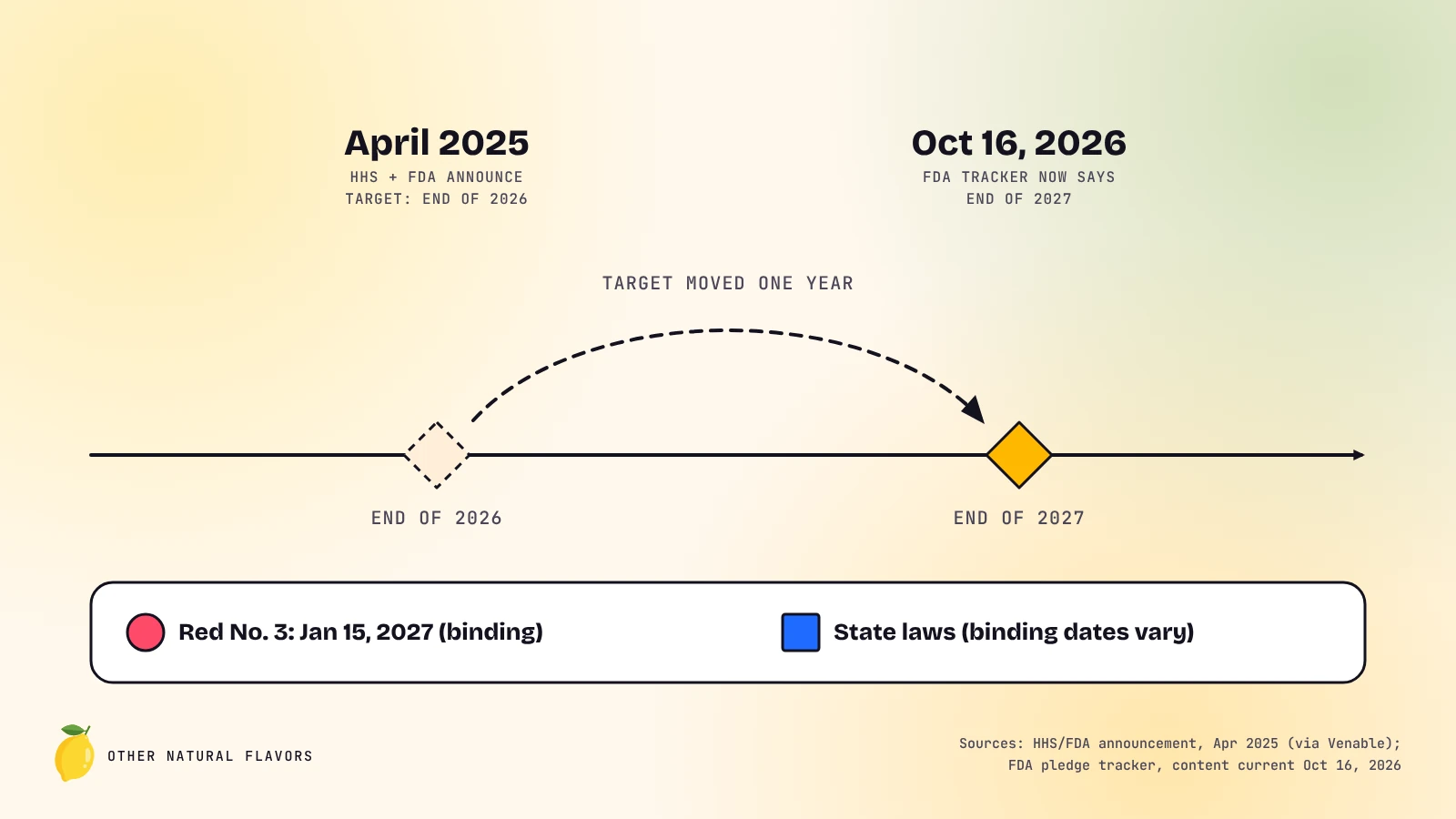
End of 2026 or End of 2027? Why the Food Dye Phase-Out Date Changed
HHS and FDA announced an end-of-2026 target in April 2025. FDA's tracker now says end of 2027. Neither is a legal deadline; Red No. 3 and state laws are.
Last checked October 31, 2026Article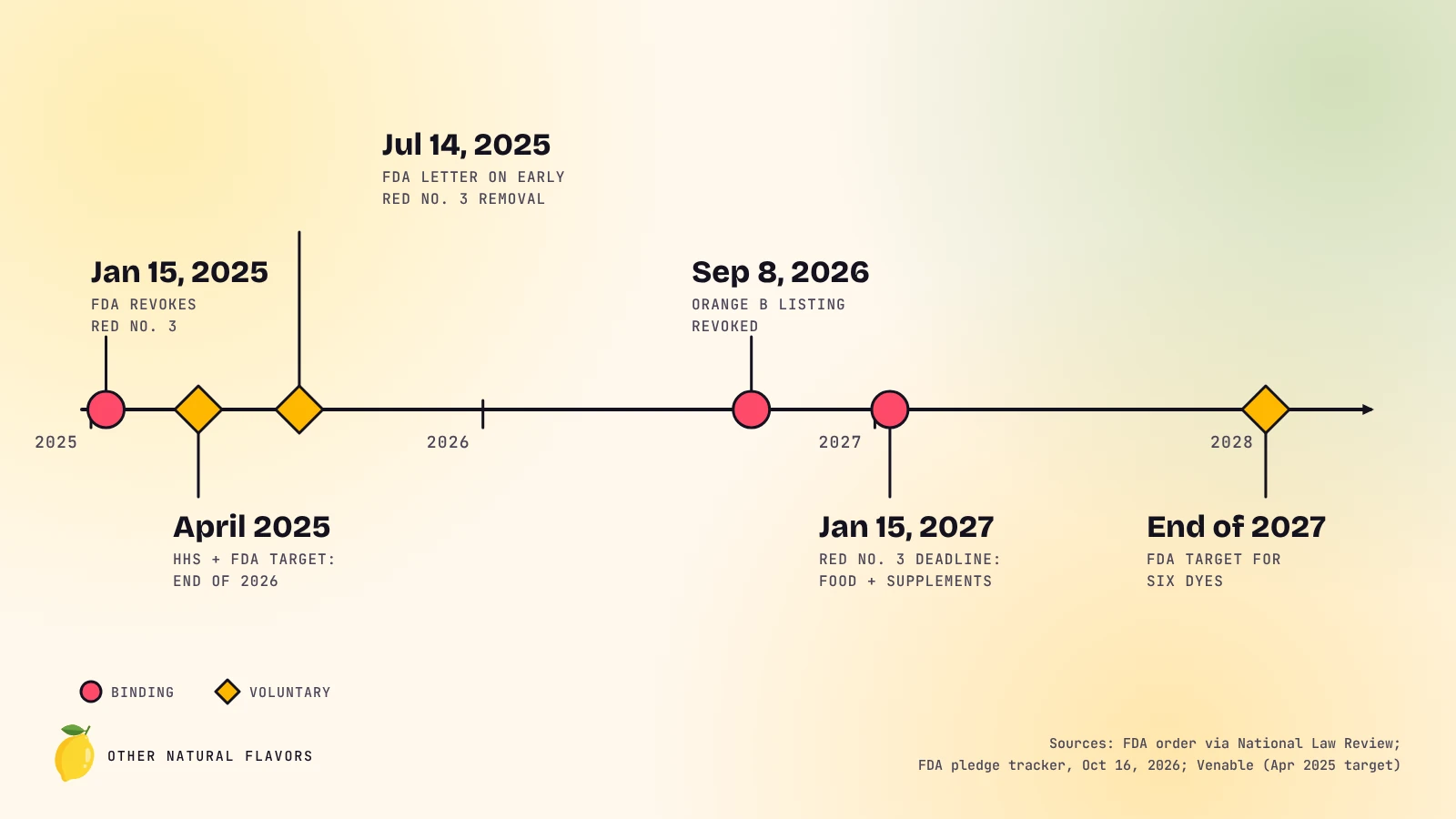
Food Dye Timeline: Every FDA Action on Synthetic Dyes, With Dates and Sources
Every FDA action on synthetic and natural food colors since January 2025, with the date, whether it is binding, and the primary source.
Last checked October 31, 2026