Red No. 3 in Supplements and Medicines: The 2027 and 2028 Deadlines
By OTHER Natural Flavors, a service of Xponent21 Inc · Last checked October 31, 2026
On this page
- The two compliance dates: foods and dietary supplements vs. ingested drugs
- Why dietary supplements fall under the 2027 food deadline
- Audit your SKU portfolio: what labels call Red No. 3
- FDA has asked companies to move ahead of schedule
- Reformulation cost and stability testing
- Action plan before your compliance date
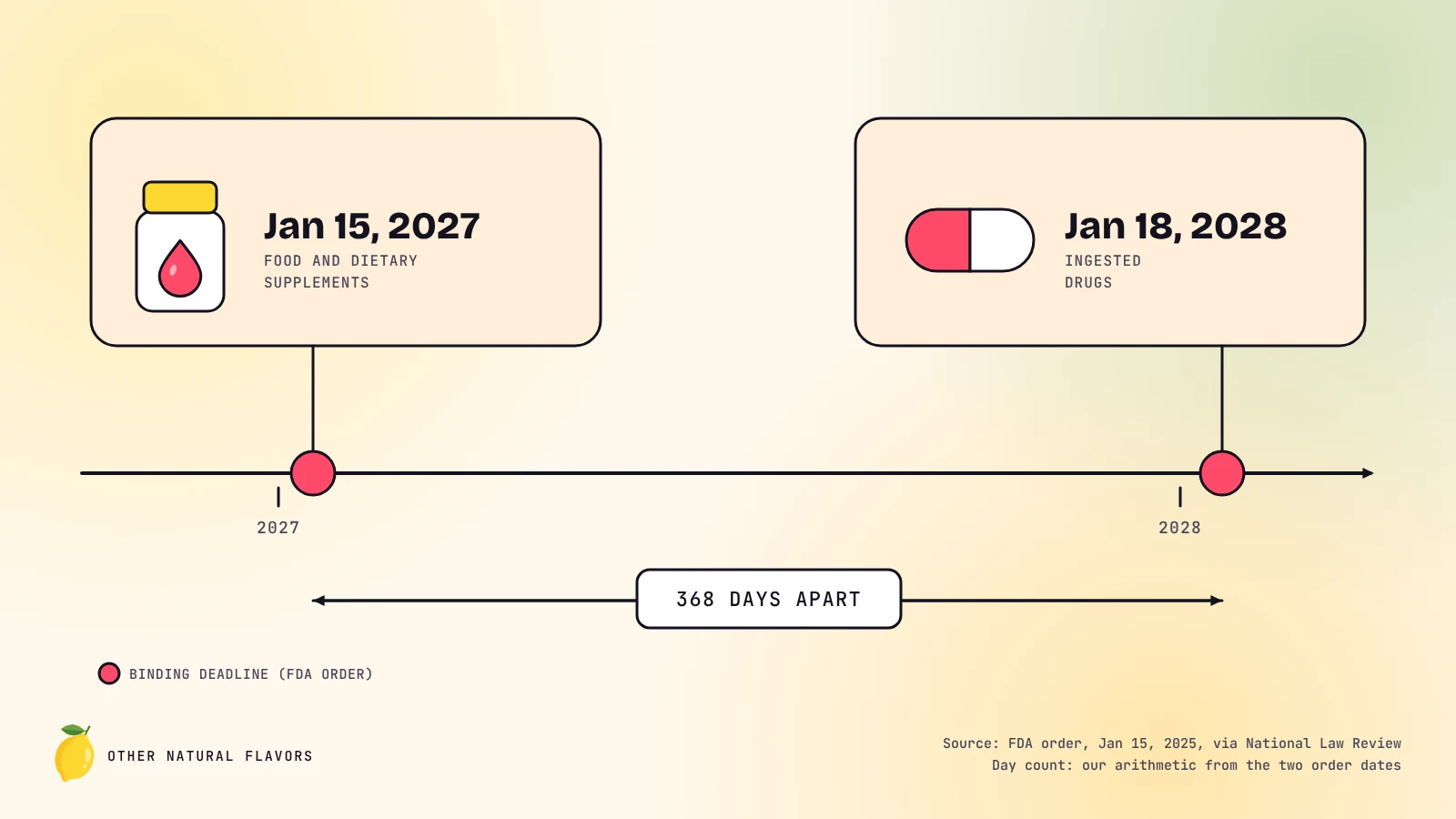
The U.S. Food and Drug Administration (FDA) has set two compliance dates for removing FD&C Red No. 3 (Red 3). Food manufacturers, including dietary supplement brands, must remove the color additive by January 15, 2027. Manufacturers of ingested drugs have until January 18, 2028. Brands that make gummies, chewable tablets, liquids, capsules and softgels need to know which date applies to each product and audit their ingredient specifications now.
The two compliance dates: foods and dietary supplements vs. ingested drugs
On January 15, 2025, FDA issued an order revoking the authorization for FD&C Red No. 3 in foods and ingested drugs, as reported by the National Law Review. The order set two dates by product category:
- Foods and dietary supplements: January 15, 2027.
- Ingested drugs (prescription and OTC): January 18, 2028.
| Product classification | Regulatory category | Compliance date | FDA program |
|---|---|---|---|
| Dietary supplements (gummies, capsules, powders) | Food | January 15, 2027 | Human Foods Program |
| Conventional foods and beverages | Food | January 15, 2027 | Human Foods Program |
| Over-the-counter (OTC) ingested drugs | Drug | January 18, 2028 | Center for Drug Evaluation and Research (CDER) |
| Prescription oral drugs | Drug | January 18, 2028 | Center for Drug Evaluation and Research (CDER) |
- Product classification
- Dietary supplements (gummies, capsules, powders)
- Regulatory category
- Food
- Compliance date
- January 15, 2027
- FDA program
- Human Foods Program
- Product classification
- Conventional foods and beverages
- Regulatory category
- Food
- Compliance date
- January 15, 2027
- FDA program
- Human Foods Program
- Product classification
- Over-the-counter (OTC) ingested drugs
- Regulatory category
- Drug
- Compliance date
- January 18, 2028
- FDA program
- Center for Drug Evaluation and Research (CDER)
- Product classification
- Prescription oral drugs
- Regulatory category
- Drug
- Compliance date
- January 18, 2028
- FDA program
- Center for Drug Evaluation and Research (CDER)
The FDA Red No. 3 page documents the revocation under the Delaney Clause of the Federal Food, Drug, and Cosmetic Act. The later drug date does not extend to dietary supplements.
Why dietary supplements fall under the 2027 food deadline
Product teams often ask whether chewable vitamins, mineral gummies or digestive supplements qualify for the later drug date. They do not. Under the Dietary Supplement Health and Education Act of 1994 (DSHEA), dietary supplements are regulated as a category of food.
The January 18, 2028 date applies only to ingested drugs, such as cough syrups, antacid chewables, pain-relief tablets and prescription capsules. If a product carries a Supplement Facts panel rather than a Drug Facts panel, the January 15, 2027 deadline applies. FDA lists color additive violations among the common reasons for warning letters and import detentions (FDA, Color Additives).
This is general information, not legal advice. Confirm each product's classification with regulatory counsel.
Audit your SKU portfolio: what labels call Red No. 3
Red 3 can enter a product through the formula itself or through a purchased component, such as a capsule shell, a coating or a color premix. Search raw material specifications, supplier certificates and batch records for all of these names:
- FD&C Red No. 3
- Red 3
- Erythrosine
- C.I. 45430
Then check each delivery format where color is added:
- Gummies: the color blend added during cooking.
- Two-piece hard capsules: the shell. Shells are often bought premade, so ask your capsule supplier for the shell's color specification.
- Softgels: the gelatin ribbon.
- Chewable and coated tablets: colored granulations, film coatings and identification bands.
- Effervescent tablets and powders: the color in the premix.
- Printed components: inks used on tablets, capsules or film coatings.
FDA has asked companies to move ahead of schedule
The binding dates are the latest a product can comply. On April 22, 2025, HHS and FDA asked food companies to remove Red 3 sooner than the dates in the order (HHS/FDA announcement). In a July 14, 2025 letter, FDA encouraged manufacturers to phase out Red 3 in foods, including dietary supplements, before January 15, 2027 (FDA letter to manufacturers).
Red 3 is not the only dye under review. FDA is working with industry to eliminate six certified color additives (FD&C Green No. 3, FD&C Red No. 40 (Red 40), FD&C Yellow No. 5, FD&C Yellow No. 6, FD&C Blue No. 1 and FD&C Blue No. 2) by the end of 2027 through a voluntary phase-out (FDA pledge tracker, content current as of October 16, 2026). A product that uses Red 3 alongside one of those six dyes can be reformulated once for all of them, with one round of stability testing.
Reformulation cost and stability testing
Replacing a synthetic dye with a natural color is rarely a one-to-one swap. Natural pigments respond differently to pH, heat, moisture, light and packaging, so each one needs bench testing in your format.
An RTI International report for the National Confectioners Association put reformulation at $50,000 to $500,000 per SKU to validate stability, run sensory testing and complete regulatory reviews (Food Dive, July 30, 2026). Costs vary with format, testing scope and the number of SKUs. See every published figure with its confidence rating in reformulation cost and timeline.
Check the regulatory status of any natural color before you build a plan around it. For example, FDA listed beetroot red as a color additive exempt from certification on February 6, 2026 (Federal Register), then delayed the order's effective date indefinitely as of March 20, 2026 after objections were filed (Federal Register, March 24, 2026). Until FDA announces a new effective date, that order does not allow beetroot red in foods. See which natural colors are listed and where each may be used in approved natural colors.
Action plan before your compliance date
To meet the January 15, 2027 date for dietary supplements or the January 18, 2028 date for ingested drugs, R&D and QA teams can take four steps:
- Find every SKU containing Red 3. Review formulas, excipients and purchased components, including capsule shells, coatings and printing inks.
- Define the target shade and process limits. Record the shade you need, the product's pH, peak processing temperature, packaging and required shelf life.
- Request samples from more than one supplier. Ask for technical data sheets and use levels so you can compare cost-in-use. OTHER Natural Flavors does not manufacture, sell or own any color or flavor supplier.
- Start real-time and accelerated stability studies. Put reformulated prototypes into light and temperature testing as early as possible.
To find synthetic dyes in your ingredient list and compare natural options across independent suppliers, run the free audit.
Related
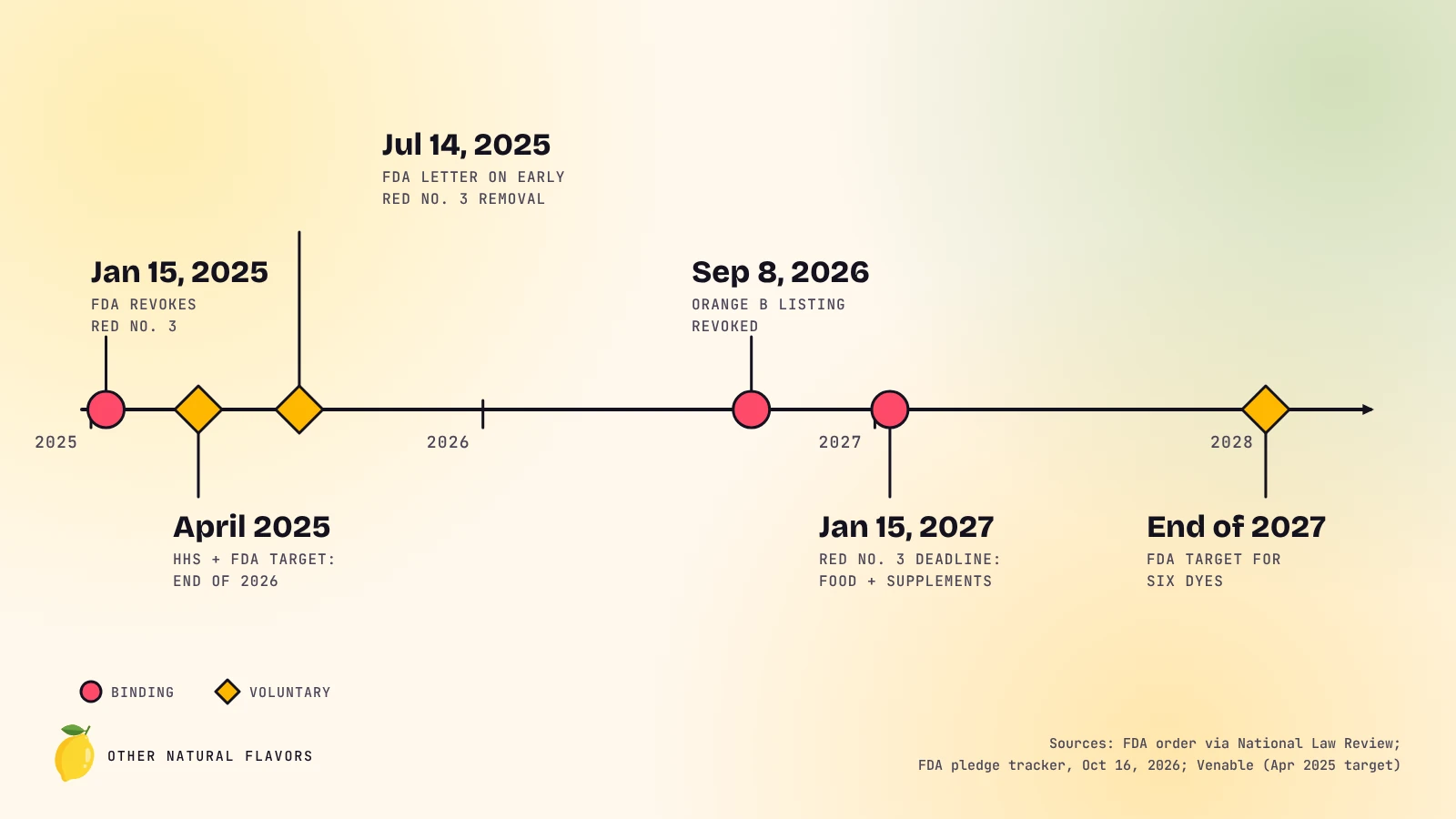
Food Dye Timeline: Every FDA Action on Synthetic Dyes, With Dates and Sources
Every FDA action on synthetic and natural food colors since January 2025, with the date, whether it is binding, and the primary source.
Last checked October 31, 2026Article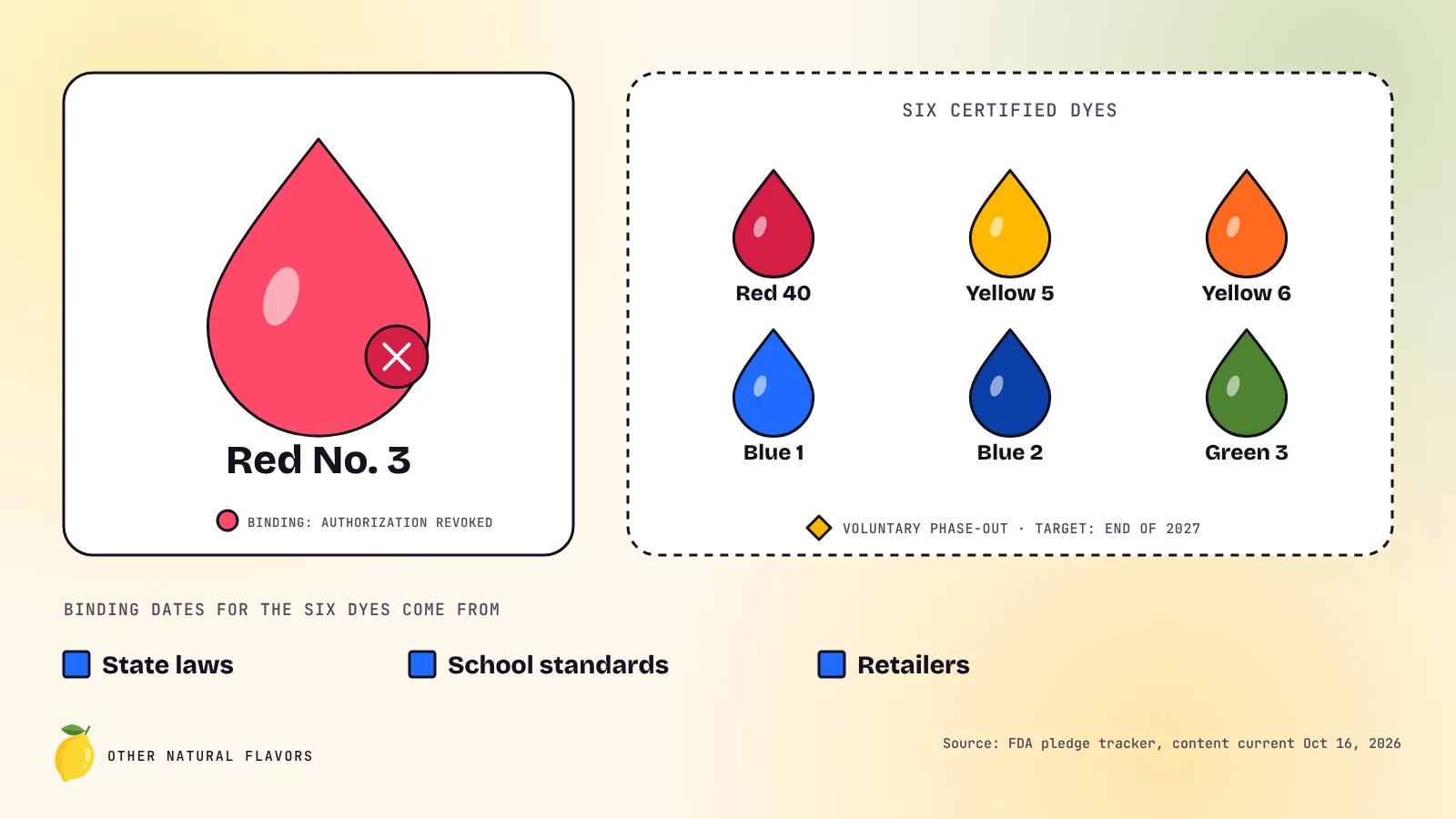
Ban vs. Voluntary Phase-Out: What FDA's Food Dye Plan Actually Requires
FDA has banned Red 3 but not the six petroleum-based dyes. For those, the binding dates come from state laws, school standards and retailers.
Last checked October 31, 2026Question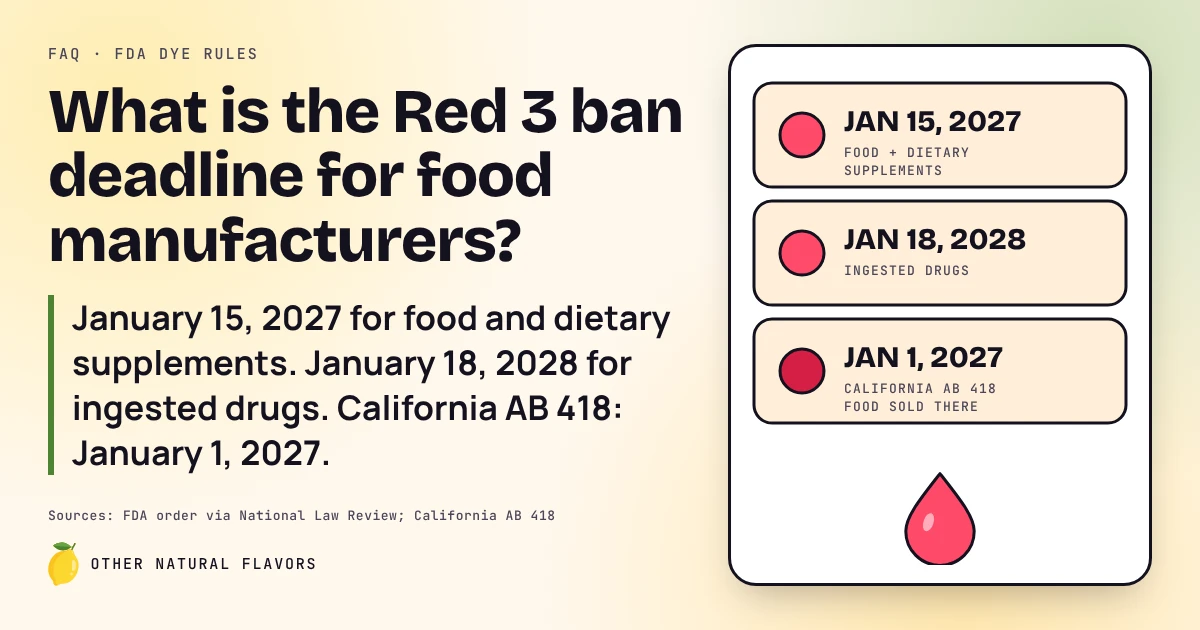
What is the Red 3 ban deadline for food manufacturers?
January 15, 2027 for food and dietary supplements, and January 18, 2028 for ingested drugs. California's AB 418 bans Red 3 in food sold there from January 1, 2027.
Last checked October 31, 2026